
Nona Kiknadze
Nona’s introduction to mindfulness occurred during her undergraduate education at Duke University, where she jointly majored in Psychology and Middle Eastern/ Asian Studies. She currently lives in Honolulu, Hawai’i and works as an Asia-Pacific intelligence analyst for the US Government. She is planning to begin her graduate studies in counseling psychology in Fall 2021 at the University of Miami. In her free time, Nona enjoys spending time outside surfing and hiking, and she maintains a daily meditation and yoga practice.
After nearly three decades, a ban prohibiting public schools to offer yoga as an elective for grades K-12 has been overturned in Alabama. The controversial bill was passed on May 17th and has made national headlines, with coverage from major national outlets, such as CNN1, NPR2, New York Times3, The Guardian4, and Al Jazeera5,6,7. The new pro-yoga legislation has been the subject of heated debate in the conservative state and has brought the debate over the secularization of yoga front and center into the national consciousness. The bill has been vocally opposed by several conservative groups, including the Eagle Forum Alabama chapter, who unequivocally equate yoga with Eastern mysticism and religious tradition8. Other conservatives have also gone on record stating that the lifting of the ban will open the doors for the State’s youth to be converted to Hinduism and therefore infringes on the 1st Amendment, which states that American public schools cannot promote school-sponsored prayer or religious indoctrination9.
State Representative Jeremy Gray first introduced the bill to revoke the yoga ban more than a year ago. A college football athlete at North Carolina State University in his youth, Gray was first introduced to yoga as a complement to his athletic pursuits. He cites the cognitive, emotional, and social benefits of yoga and mindfulness as advantages of introducing these programs into school curriculums.
Research on the psychological and physiological effects of yoga have increased exponentially in the past few years. In the past two years alone, research has provided evidence for yoga’s positive effects across a wide variety of contexts and populations, such as: improving self-regulation skills in vulnerable populations10, promoting positive health outcomes amongst adults with intellectual and developmental disabilities11, reducing negative affect amongst survivors of sexual trauma12, decreasing chronic pain13, improving divergent thinking associated with creative ability14, reducing anxiety15, and improving body image in young women16. It is important to note that due to the wide variety of yoga styles practiced today, using “yoga” as an umbrella term for all research makes it challenging to comparatively evaluate research on the health benefits of all styles. It appears that the majority of studies that refer to “yoga” programs utilize the Hatha style of yoga.
In addition, the associated fields of mindfulness and meditation research have grown dramatically over the last decade. The use of yoga and meditation for children has significantly increased in the U.S in the past few years, according to the CDC’s National Center for Health Statistics (NCHS). A 2017 study, the “Use of Yoga, Meditation and Chiropractors Among U.S. Children Aged 4–17 Years,” revealed that the use of meditation increased significantly for U.S. children from 0.6% in 2012 to 5.4% in 2017 and that U.S. children who used yoga in the past 12 months also increased significantly from 3.1% in 2012 to 8.4% in 201717. The Centers for Disease Control and Prevention (CDC) explicitly promotes the use of yoga and meditation in schools on its website, stating that “yoga leads to improved physical fitness, increased ability to concentrate, and decreased stress” for children18.
The Alabama bill has undergone several key modifications since its inception over a year ago, and the final legislation has been scrubbed clean of any references to yoga’s historical or cultural roots. The bill contains language restricting school personnel from using “hypnosis, the induction of a dissociative mental state, guided imagery, meditation or any aspect of Eastern philosophy.” Participants will be barred from using the traditional Sanskrit greeting “namaste,” and chanting “om,” and from using the Sanskrit names for poses19. This is not the first time in recent history that introducing yoga into American schools has been met with heated debate. In 2016, Bullard Elementary School in Kennesaw, GA became the subject of controversy after introducing a yoga program into its curriculum. After strong objections from parents, the program was restructured to remove the “namaste” greeting, to place hands in prayer position at “heart center,” and to conduct mandala coloring exercises20.
“Vocal critics of incorporating yoga into school curriculums who equate yoga with Eastern religion and tradition often argue that the line between the secular practice of yoga and its origins are blurred. While it is undeniable that yoga’s roots are based in Hindu and Buddhist tradition, it is clear that modern yoga has drastically departed from its historical manifestations.”
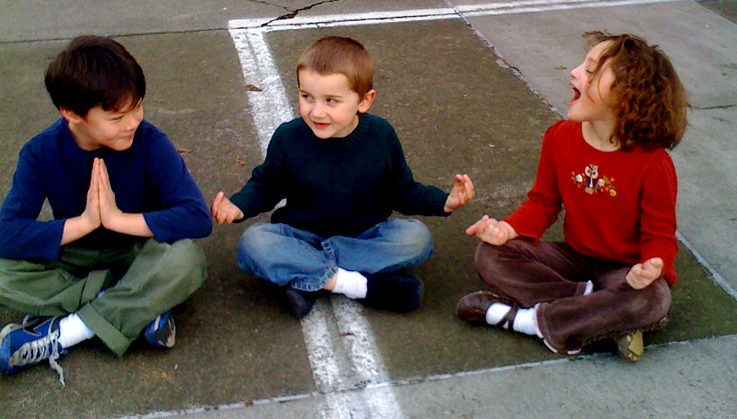
In reality, school-based yoga programs are less of an indoctrination in theology and philosophy and are more often built around very simple secular yoga and meditation curricula. These often contain simple physical poses that are cued with entertaining stories or songs to retain the attention of children, and plan for some time spent focusing on relaxation and mindfulness21. The format in which this yoga is delivered can vary, with some school programs incorporating yoga into a PE class, an after-school program, or during breaks in the classroom to get students up from their desks22. Interestingly, the Alabama bill does not clearly demarcate between mindfulness and meditation training, so while meditation is explicitly called out as forbidden, it is unclear if school curriculums will teach children some components of mindfulness in conjunction with yoga. As anyone who has taken a yoga class will attest, mindfulness and meditation are often intrinsically integrated into yoga, as the practice naturally promotes attention to the present moment, awareness of physical and mental states, and concentration on the task at hand.
Vocal critics of incorporating yoga into school curriculums who equate yoga with Eastern religion and tradition often argue that the line between the secular practice of yoga and its origins are blurred. While it is undeniable that yoga’s roots are based in Hindu and Buddhist tradition, it is clear that modern yoga has drastically departed from its historical manifestations. If a Hindu priest stepped into a cardio-based, 90-degree hot yoga class on a Saturday morning, with an energetic teacher instructing the class to pump their arms and squat, they would hardly recognize the scene as yoga. For better or worse, it’s not uncommon to walk into a yoga class that’s been stripped of its philosophical and historical context and has been rebranded as an exercise sequence. Granted, modern classes will often incorporate aspects of mindfulness and meditation, but the practice of yoga as it stands now compared to its roots is widely posture-based. This is a stark departure from the practice of yoga in the Hindu tradition, where yoga was seen primarily as a process of meditation and introspection.
The origin of “yoga” can be traced back to the Vedas, the ancient Hindu scriptures composed over 5,000 years ago, specifically the Rig Veda of 1500-1200 BC23. The Vedas were a collection of texts containing mantras and rituals to be used by the elite class of Brahmans, the Vedic priests. (The word “yoga” originates from these texts and is a translation of the Sanskrit words of “yoking” or “union.”) Following the Vedas, Patanjali created the Yoga Sutras around 500 BC, which contained the first written systematic presentations of yoga: the unifying theory of the Eight Limbs of Yoga, or ashtanga, as they are known in Sanskrit. The Eight Limbs are guidelines on how to live a purposeful and meaningful life and are made up of the principles of yama (moral restraints), niyama (observances), asana (postures), pranyama (breath control), pratyahara (withdrawal of the senses), dharana (concentration), dhyana (meditation), samadhi (enlightenment)24. The postures originally described by Patanjali were seated, meditative poses, rather than the acrobatic postures seen in modern yoga practice, and the emphasis was on mindfulness, breathing, concentration and meditation rather than on physical movement. The Yoga Sutras were followed by the Tantra and Hatha Yoga traditions, which later expanded into several other lineages. Now there are a wide variety of yoga styles, such Restorative, Yin, Hatha, Vinyasa, or specific sequences and trainings like Iyengar, Ashtanga or Bikram, to name a few. In fact, the poses we recognize in modern yoga are largely attributed to relatively new interpretations arising from the last 200 years25.
“Granted, modern classes will often incorporate aspects of mindfulness and meditation, but the practice of yoga as it stands now compared to its roots is widely posture-based. This is a stark departure from the practice of yoga in the Hindu tradition, where yoga was seen primarily as a process of meditation and introspection.”
Yoga as it is practiced in the West encompasses a wide variety of techniques and styles, some more spiritual than others. Critics of the incorporation of yoga in schools can point at the customary bowing during a greeting of “namaste” in a class, or the Sanskrit names given to poses as evidence of yoga’s cultural tradition, but it is just as easy to find a yoga class with these elements as one without. For every teacher who cues the class into tadasana, there is another who uses the English name, “mountain pose.” The debate surrounding the cultural appropriation of yoga is complex and will not be addressed here, but ultimately the exploding popularity of yoga around the world attests to the utility of this practice in helping people focus, relax, and connect with their bodies, be that in whatever form it is practiced.
Despite criticism by conservative groups in the U.S. who believe yoga to be an esoteric religious tradition, the health benefits of yoga and mindfulness are getting harder to ignore. While the research in this field has dramatically increased in the last decade, there is still a long way to go in providing scientific evidence for the benefits of yoga and meditation, especially in youth populations. Further research is needed to clarify the benefits of yoga programs and the pathways underlying these benefits, including the best practices for the implementation of yoga programs in schools.
References
1. https://www.cnn.com/2021/05/22/us/alabama-yoga-in-schools-ban-overturned-trnd/index.html
2. https://www.npr.org/2021/05/21/999020140/its-now-legal-to-practice-yoga-in-alabamas-public-schools
3. https://www.nytimes.com/2021/05/20/us/alabama-yoga-ban-public-schools.html
4. https://www.theguardian.com/us-news/2021/apr/17/alabama-yoga-ban-public-schools-christian-groups
5. https://www.aljazeera.com/news/2021/5/21/alabama-lifts-ban-on-yoga-in-public-schools
6. https://www.npr.org/2021/05/21/999020140/its-now-legal-to-practice-yoga-in-alabamas-public-schools
7. https://legiscan.com/AL/text/HB246/2021
8. https://www.npr.org/2021/05/21/999020140/its-now-legal-to-practice-yoga-in-alabamas-public-schools
9. https://www.aclu.org/other/establishment-clause-and-schools-legal-bulletin
10. https://www-sciencedirect-com.access.library.miami.edu/science/article/pii/S0149718921000410
11. https://www-sciencedirect-com.access.library.miami.edu/science/article/pii/S1744388121000311
12. https://www-sciencedirect-com.access.library.miami.edu/science/article/pii/S0965229921000704
13. https://www-sciencedirect-com.access.library.miami.edu/science/article/pii/S0965229921000637
14. https://www-sciencedirect-com.access.library.miami.edu/science/article/pii/S0001691819305505#bbb0135
15. https://www-sciencedirect-com.access.library.miami.edu/science/article/pii/S0883941718304795
16. https://www-sciencedirect-com.access.library.miami.edu/science/article/pii/S1740144518301943
17. https://www.cdc.gov/nchs/pressroom/nchs_press_releases/2018/201811_Yoga_Meditation.htm
18. https://www.cdc.gov/healthyschools/bam/cards/yoga.html
19. https://www.npr.org/2021/05/21/999020140/its-now-legal-to-practice-yoga-in-alabamas-public-schools
20. https://www.washingtonpost.com/news/morning-mix/wp/2016/03/24/ga-parents-offended-by-the-far-east-religion-of-yoga-get-namaste-banned-from-school/
21. https://www.littlefloweryoga.com/the-school-yoga-project/
22. https://www.theatlantic.com/education/archive/2018/09/why-schools-are-banning-yoga/570904/
23. https://www.britannica.com/topic/Veda
24. https://chopra.com/articles/what-are-the-8-limbs-of-yoga
25. https://www.verywellfit.com/how-old-is-yoga-the-history-of-modern-yoga-asana-3566729
Enjoy? Share with your friends
Share on facebook
Share on twitter
Share on linkedin
Share on reddit